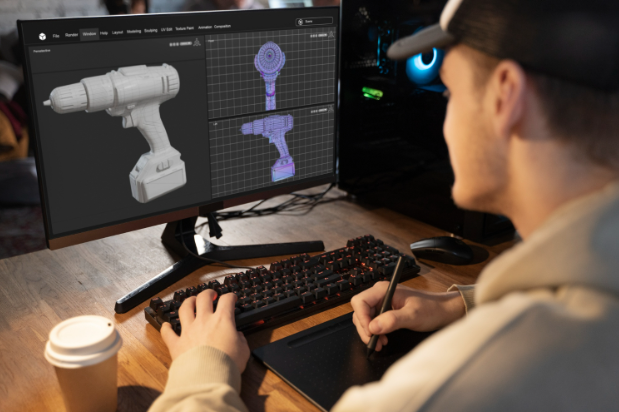
The face of online getting to know is being revolutionised with a shift from two-dimensional video and textual content modules closer to complete immersion and interactivity. At the vanguard of this revolution is the enhanced use of 3d model visualisation, which is imparting teachers remarkable opportunities to make difficult-to-visualise standards greater tangible, simulate actual-international settings, and enhance learner engagement. 3d models permit students to touch and sense digital gadgets, study complicated structures from all facets, and experience intangible ideas concretely. For schools and online learning platforms that wish to take advantage of this feature, collaborating with seasoned 3d model design services is emerging as a central strategy for creating the next generation of digital learning tools that are outstandingly effective and deeply engaging.
Augmented Visualisation of Complex Concepts
3D model design revolutionises learning by making abstract or complex concepts tangible and interactive visualisations. Students learn about the human body in biology by virtually dissecting organs, rotating a complex molecular structure in chemistry to understand bonds, or examining a historic archaeological artefact from any angle. This is from passive observation to active discovery, with much higher understanding and recall of information. Complex spatial relationships and machinery hard to describe in 2D images or words become clear when students themselves get to touch and move around a 3D model, with barriers to understanding removed.
Interactive and Gamified Learning Experiences
With the use of 3D models, teachers can develop very interactive gamified learning experiences. Difficult topics can be made into puzzle or discovery quests that are gamelike or interactive, in which students are rewarded for achieving objectives like uncovering fragments of a 3D engine or solving a history puzzle by decoding virtual artefacts. This game-like strategy boosts motivation, enhances healthy competition, and renders learning a fun task. The rationale of interactivity in collaborating with 3D objects has the effect of concentrating attention and transforming learning from an inactive chore to an active and interactive experience and resulting in improved completion rates.
Improved Accessibility and Customisation
3D models provide excellent scope for accessibility and personalised learning. Visualisations may be tailored to suit varying learning styles; some students can learn through simplified models, while others can investigate highly detailed ones. For students with disabilities, 3D spaces are explored and accessed differently, with level access to information. In addition, the students drive the rate of interaction, stopping, rotating, and zooming in on models as they choose, so they completely understand each topic before advancing. This autonomous inquiry accommodates varying learning needs in one virtual world.
Scalable and Cost-Effective Educational Tools
Though initial creation is a cost, 3D models are extremely scalable and inexpensive over the long term. One good quality 3D model of a heart or that of an ancient monument can be used to serve a thousand students at once worldwide, avoiding money being wasted on costly physical models, lab equipment, or trips. They do not wear out, get damaged, or need to be maintained. This scalability enables high-quality, interactive teaching materials to reach individuals and institutions that have budget limitations, reducing economic entry points to education and offering standardised quality of teaching materials to all.
The Gap Between Theory and Practice
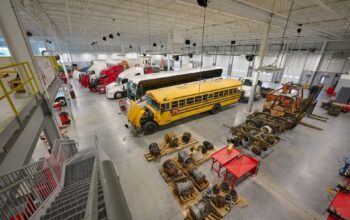
3D design eliminates the typically broad gap between theoretical and practical use very effectively. For professional and career training, students can work with virtual tools that are the same as the ones they will be working with when they are employed. An automechanic’s apprentice can take apart a sophisticated engine, a potential architect can walk through a building design, and an astronaut can practice a spacewalk all within a real-world 3D simulation. This direct application of theory develops muscle memory, processes knowledge, and confidence and leads to more effective and efficient entry into actual work and professional careers.
Future-Proofing Education with AR and VR Integration
Investment in 3D assets is a crucial step to future-proof education. Such models serve as the building block for upcoming technologies such as Augmented Reality (AR) and Virtual Reality (VR). A 3D model created for an internet module is simply embedded in an AR application to have the ability to toss a life-sized hologram of a dinosaur around one’s living room, or in a virtual reality headset to be completely immersed in a complete simulation for training. By developing a library of 3D learning objects today, schools are well-positioned to readily infuse these revolutionary technologies seamlessly into their courses when they become mainstream, and their programs will always be at the leading edge.
Conclusion
The methodology of 3D model creation is really transforming the future of e-learning by turning it from a passive, two-dimensional process into an active, immersive, and highly interactive endeavour. Its ability to conceptualise the intricate, generate safe practice environments, and enable worldwide collaboration exceeds current limitations in computer-based instruction. In addition, the built-in scalability, flexibility, and affordability of computer models bring high-quality, interactive learning within reach as never before. As the basis for the future ed-tech of AR and VR, investment in 3D design is not an upgrade but a requirement to construct effective, future-oriented learning environments that meet the multidimensional needs of learners globally.